Posted on

Woven History of Murrayville

Woven History of Murrayville

Over a six month period, I worked with about 40 locals to create a body of artwork for Murrayville. The exhibition opened on 6 November.
 – Morrison Polkinghorne

Murrayville’s history woven into new exhibition in Red Cliffs
 
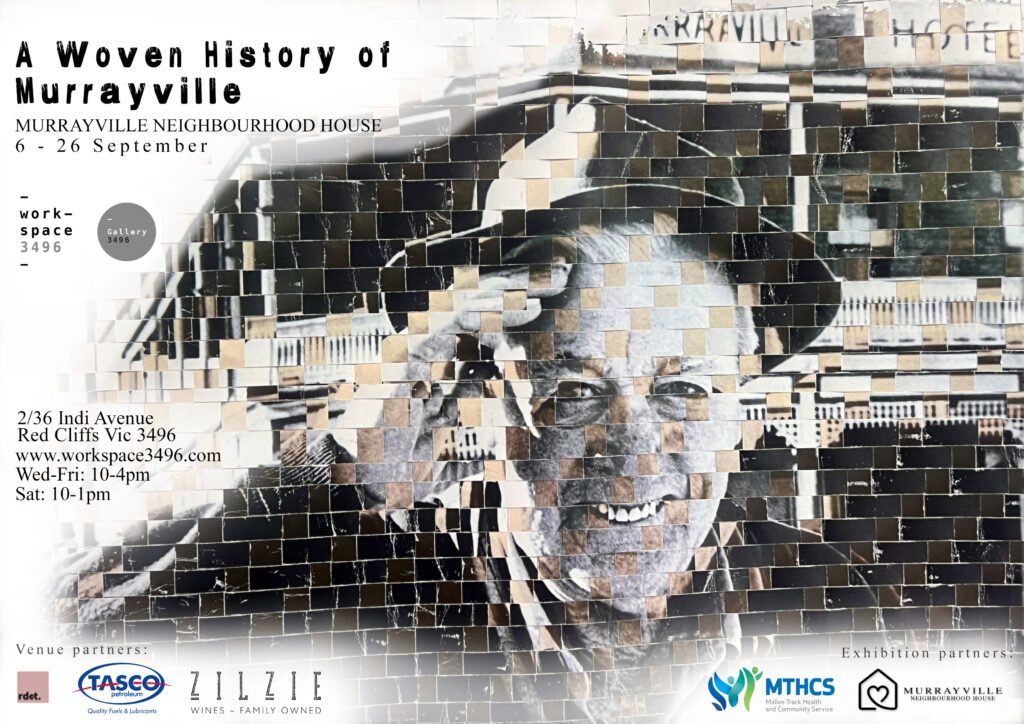
Murrayville’s photographs, memories and stories have been given new life in A Woven History of Murrayville, a community exhibition opening at Workspace 3496 + Gallery in Red Cliffs on Sunday 6 September.
 
Opening from 9am to coincide with The Red Cliffs Country Market, the exhibition transforms historical photographs of Murrayville and the surrounding district into intricate contemporary artworks.
 
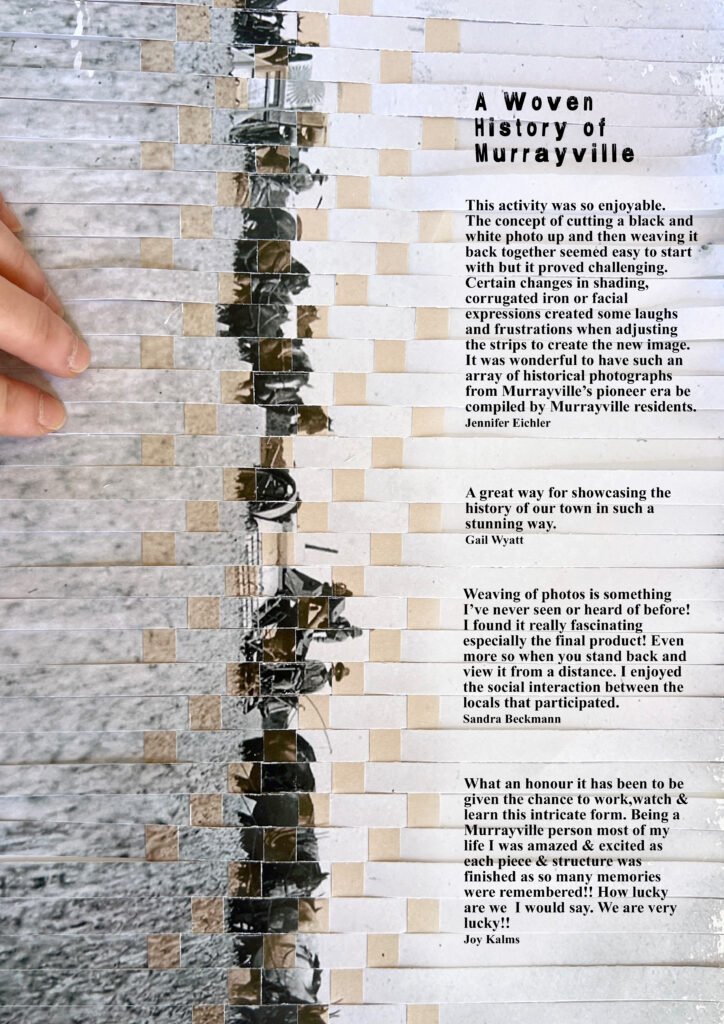
Photographs have been reprinted, cut into strips and carefully woven back together, creating new interpretations of familiar people, places and landscapes.
 
Workspace 3496 + Gallery Director Rohan Morris said bringing the exhibition to Red Cliffs reflected the gallery’s commitment to supporting and providing opportunities for creatives from across the Mallee.
 
“Some really exciting creative work is happening in our smaller communities across the Mallee, and I want Workspace to be a place where that work can be seen, shared and celebrated,” Mr Morris said.
 
“This is a great community arts project. It brings together creativity, local history, storytelling and community participation, and I’ve loved being able to bring it from Murrayville to Red Cliffs and share it with a new audience.”
 
At the heart of the project is the idea that a single strand has little strength or structure on its own, but when woven together with others it becomes something stronger. The same can be said of community.
 
Local residents were invited to contribute photographs from Murrayville’s past. As the images were gathered, so too were stories and memories about people, families, farming and life in the district.
 
Historical skies, paddocks, buildings and faces are interrupted by the patterns of the weave. Rather than simply reproducing the past, the works encourage viewers to look at familiar images differently and consider how memories and stories are carried from one generation to the next.
The exhibition also includes audio recordings of old sayings and expressions once commonly heard across remote Victoria, adding another layer of memory and storytelling.
 
Mr Morris said Murrayville Neighbourhood House Coordinator and most recent Elliott Award recipient Morrison Polkinghorne was demonstrating what could be achieved through ambitious community based creative projects.
 
“Morrison is doing amazing things in Murrayville. There is a real energy around the work coming out of the Neighbourhood House and a willingness to think creatively about how arts, history and community can come together,” Mr Morris said.
 
“Projects like this show that geography doesn’t need to be a barrier to making interesting and meaningful creative work. There are extraordinary stories and creative people right across the Mallee, and we should be finding more ways to connect them with audiences across our region.”
The project has been supported by Murrayville Neighbourhood House and Mallee Track Health and Community Service.
 
A Woven History of Murrayville will be on display at Workspace 3496 + Gallery from 6 to 26 September 2026.
 
The exhibition will open from 9am on Sunday 6 September during The Red Cliffs Country Market, with the official opening at 1pm. The community is warmly invited to attend.
 
EVENT DETAILS
A Woven History of Murrayville
Workspace 3496 + Gallery
2/38 Indi Avenue, Red Cliffs
6 to 26 September 2026
 
Sunday 6 September
Open from 9am during the Red Cliffs Country Market
Official Opening at 1pm

Posted on

Paris Exhibition

Paris Exhibition

Cambodia, off the beaten track
Galerie Lee
December 2-22 2020

Australian artist Morrison Polkinghorne’s latest series of artwork is exhibited at Galleria Lee. Entitled “Cambodia Off the Beaten Tracks”, the exhibition covers the local artist’s seven years living in that Southeast Asian country before returning to his homeland iAustralia earlier this year.  The exhibition s jointly hosted by Batia Sarem gallery in Siem Reap Cambodia.  

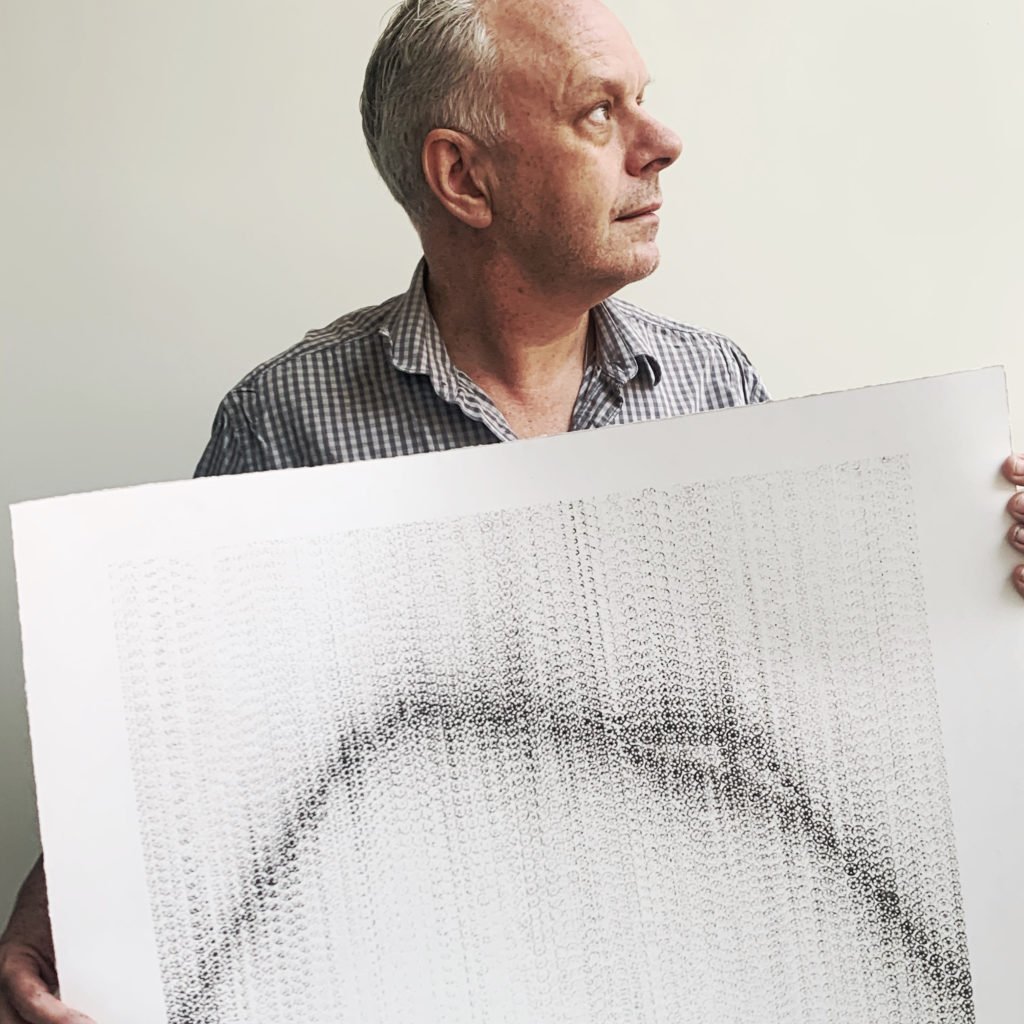
During Morrison’s eight year sojourn in the kingdom, he while living in Cambodia Morrison developed his artwork and technique, mastering ink making using local distillations, which he uses to craft his drawings.  In Cambodia his ink derives from lotus flowers, ever plentiful in the kingdom and symbolic of Buddhism — Sacred Ink so to speak. Likewise, in the Mallee, Morrison uses local flowers, barks and soils to paint his pieces.

While the local artist’s Aussie works focus on monochromatic landscapes, his pieces also incorporate aspects Chinese and Japanese calligraphy. Likewise, his current Paris works exhibit a form of Pointillism, pressing lotus stalks into the ink then onto paper, creating visual impressions filling a page with its markings. Fittingly, Morrison, who originally hails from outback Australia, incorporates elements reminiscent of Aboriginal dot paintings. A single work may total up to 20, 000 impressions. 

Morrison’s love of handmade items remain his forte, as he was previously  known for artisan passementeries decorative arts, hand-trimmings and tassels. His textiles grace Kirribilli House and Vaucluse House in Sydney, and other Historic Homes in the country.

Likewise, numerology has an important element in his art.  Having a background in weaving, Morrison taught himself to repetitively count. Any weaver knows the importance of tallying the number threads and the amount of times the shuttles passing through warp. Consequently, each and every artwork records the actual number of impressions on each. This Paris exhibition has a grand total 23,930 lotus impressions.

Morrison recently left Cambodia for his native Australia due to Covid, and is now renovating a the former St John’s Anglican church in Murrayville  for both home and studio.

Morrison’s  art is holistic and regenerative, while his message is universal.

Posted on

Workshop and Artist talk

Workshop and Artist talk

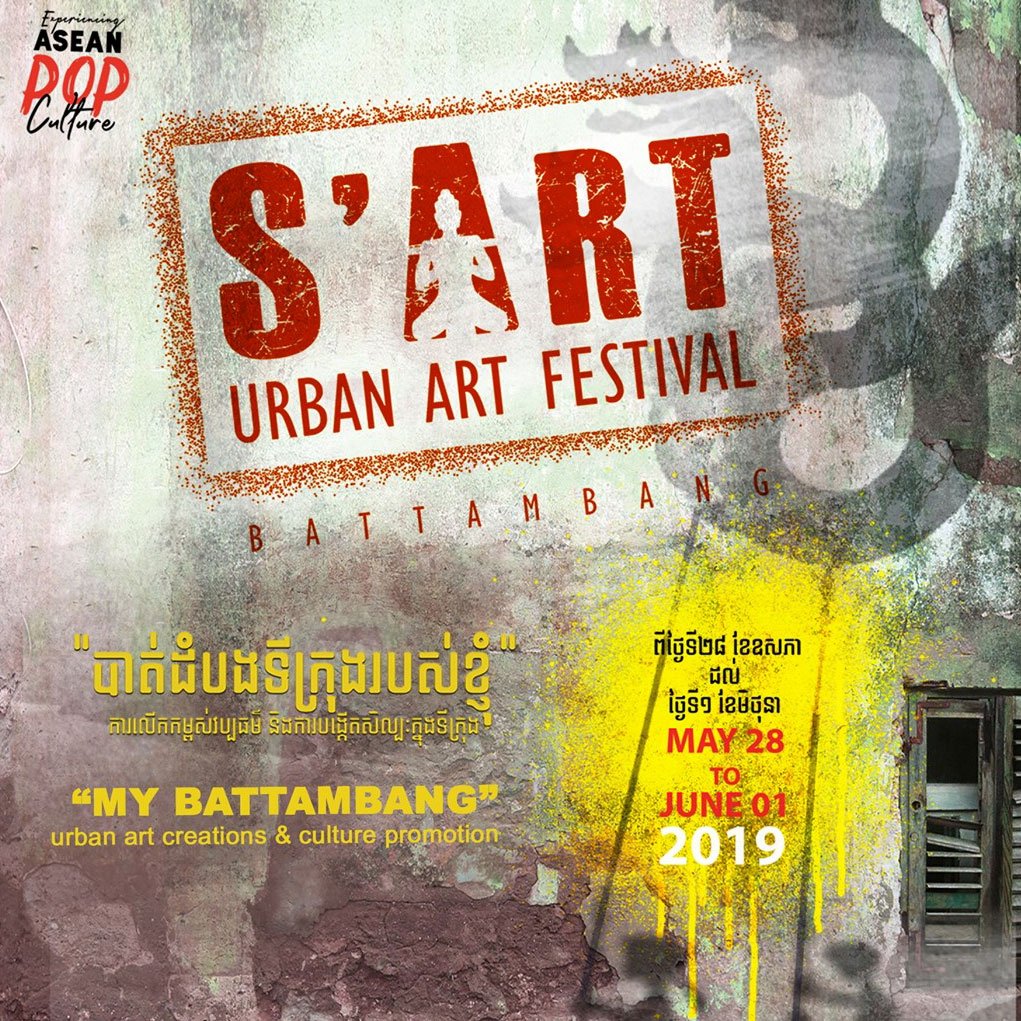
The S’Art Urban Art Festival runs now in Battambang, and I am conducting two workshops at Bric-a-Brac during the week-long event. Attendance is free and no reservaitons required… just rock up!


Friday 31 May
1:30-3pm
I explain classic European tassels, fringe and cord making.  

Saturday 1 June from
5-6:30pm
It’s all about  my lotus ink and art (and my exhibition currently showing at Serindia Gallery in Bangkok).  Immediately afterwards, join us that Saturday evening at Bric-a-Brac Libations Bar to watch the S’Art Phare puppet parade pass by on St. 2.  All of our bar proceeds that night will go to Phare Ponleu Selpak.  

Morrison Polkinghorne @ Bric-a-Brac 
2 Street @ 119, in the city’s colonial heart
(one block south of Psar Nat, and 1 block west of Sangkae river)
www.Bric-a-Brac.Asia
077 531 562

facebook.com

Posted on — Leave a comment

148913: Paths of the Lotus Ink

Bangkok Exhibition
with 29 works of art and 148913 lotus impressions

from 6pm, 16 May-30 June 2019
Serindia Gallery Bangkok

My path to creating art alludes to both the practice of making of artworks, and equally the symbolism of the materials used. My themes are indirect allusions to deeper messages without spelling out literally what is going on. The lotus is a symbol of Buddhism precisely because it is an allusion to the life cycle; to the path of enlightenment and to the ephemerality of humanity and all life. It points the way in terms of approach, not telling you what to think or do.

Read more:

Posted on

Awarded number one Cookbook of the year, The Burma Cookbook, Asian

The Burma Cookbook, awarded number one asian cookbook of the year

We won!

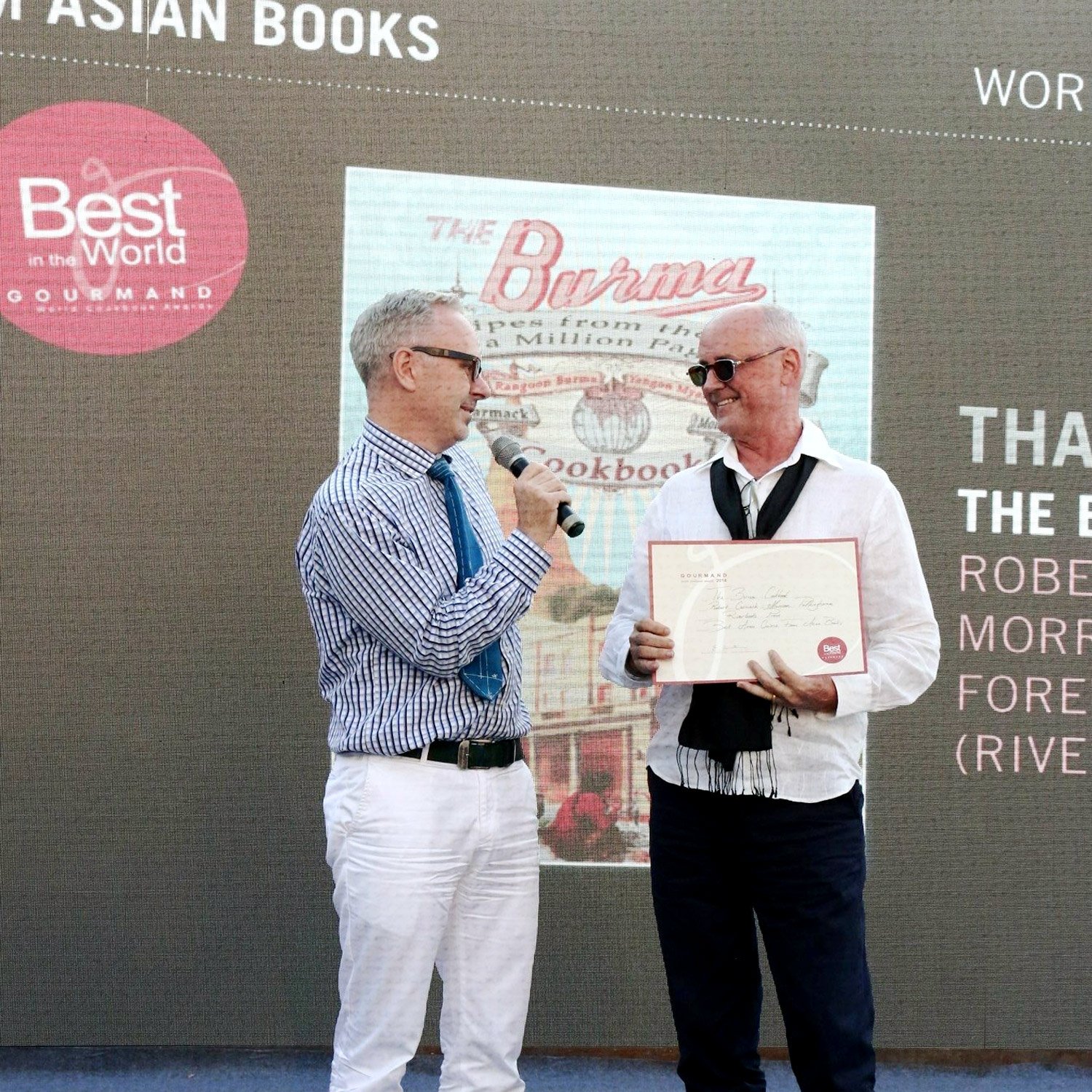
The Burma Cookbook won World’s Best Asian cookbook of the year at Gourmand World Cookbook.
Competing against entries from some 205 countries and thousands of titles, The Burma Cookbook vied against four finalists from all books published in Asia.

A lavishly photographed cookbook and historic travelogue, tracing contemporary and colonial Burmese dishes over the past century. With its rich traditions of empire, The Burma Cookbook highlights the best of present-day Myanmar, including foods of its immigrant populations – from the subcontinent, down the Malay peninsula, and Britain itself. The authors spent some ten years researching the book, while organising and hosting culinary tours to uncover the country’s most popular dishes. The authors had exclusive access to The Strand Hotel’s collection of historic menus, pictures and photos, while contemporary photography by Morrison Polkinghorne portrays Myanmar street life.